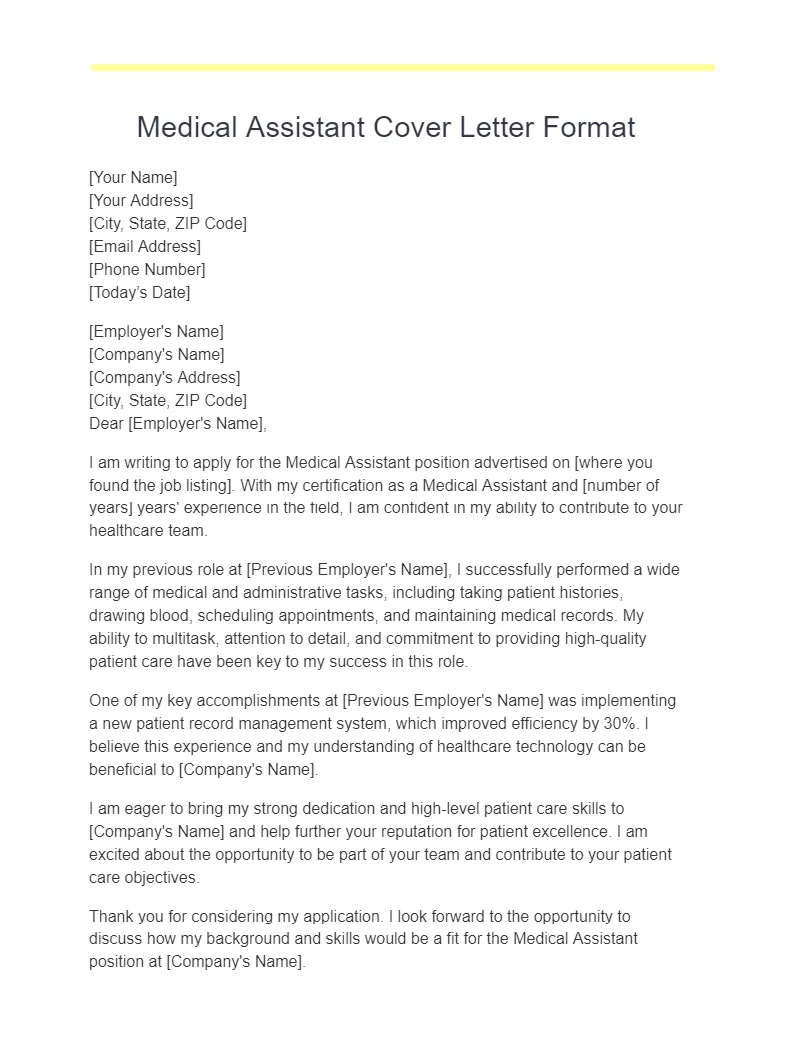
Understanding the Medical Assistant Cover Letter
A medical assistant cover letter is more than just a formality it is your first opportunity to make a strong impression on a potential employer. It serves as an introduction, allowing you to highlight your key skills, experience, and passion for the medical field. Unlike your resume, which provides a factual overview of your qualifications, the cover letter gives you the chance to tell your story, explain your career goals, and express why you are the ideal candidate for the specific medical assistant position. A well-crafted cover letter demonstrates your communication skills, attention to detail, and genuine interest in the role, increasing your chances of getting an interview and ultimately, landing the job.
Purpose of a Cover Letter
The primary purpose of a medical assistant cover letter is to secure an interview. It’s your personal marketing tool, designed to persuade the hiring manager that you are worth their time. The cover letter complements your resume by providing context and personality. It allows you to elaborate on your qualifications, connect your skills to the job requirements, and showcase your enthusiasm for the position and the healthcare organization. Furthermore, the cover letter helps you differentiate yourself from other applicants by highlighting your unique strengths and experiences that make you the best fit for the role. By using a cover letter, you proactively address the employer’s needs and demonstrate how you can contribute to their team and patient care.
Key Components of a Medical Assistant Cover Letter

A well-structured medical assistant cover letter typically consists of several key components that work together to create a compelling application. These include your contact information, the date, the hiring manager’s name and title (if known), and a professional salutation. The body of the letter should open with a strong introductory paragraph that grabs the reader’s attention and states your purpose. Follow this with one or two paragraphs highlighting your relevant skills and experience, using specific examples to demonstrate your capabilities. A paragraph expressing your enthusiasm for the position and the organization is essential. Finally, the closing paragraph should reiterate your interest, include a call to action (e.g., requesting an interview), and express your gratitude. Always proofread the entire letter to avoid errors.
Contact Information and Salutation
Begin your cover letter by providing your contact information at the top left or right corner of the document. This should include your full name, phone number, email address, and optionally, your LinkedIn profile URL. Directly below your information, include the date and the hiring manager’s name, title, and the organization’s address. Addressing the hiring manager by name, if possible, is essential to show that you have taken the time to research and personalize your application. If you cannot find a specific name, use a professional salutation like “Dear Hiring Manager” or “Dear [Department Name] Hiring Team.” Avoid generic greetings like “To Whom It May Concern.”
Highlighting Skills and Experience
The core of your medical assistant cover letter is where you highlight your relevant skills and experience. This is the section where you show the hiring manager why you are the best candidate. Begin by identifying the key skills and qualifications the job description requires, such as clinical skills (e.g., taking vital signs, assisting with examinations), administrative skills (e.g., scheduling appointments, managing patient records), and soft skills (e.g., communication, empathy). Provide specific examples from your previous experiences that demonstrate how you have successfully used these skills. Focus on quantifiable achievements, such as the number of patients you assisted, the efficiency improvements you contributed to, or positive feedback you received from patients or colleagues.
Showcasing Relevant Skills

When showcasing your relevant skills, make sure to align them with the specific requirements listed in the job description. The skills can range from clinical abilities like taking patient histories, preparing examination rooms, and administering medications, to administrative proficiencies such as managing patient records, handling insurance claims, and scheduling appointments. Provide concrete examples of how you have utilized these skills effectively in past roles. For example, if the job description emphasizes experience with electronic health records (EHR) systems, detail your proficiency with the specific software and how you utilized it to improve efficiency or accuracy.
Quantifying Achievements
Quantifying your achievements is a powerful way to make your cover letter stand out. Instead of simply stating your responsibilities, use numbers and data to illustrate your impact. For example, you could mention how you improved patient satisfaction scores by a certain percentage, reduced appointment scheduling errors by a specific amount, or efficiently managed a high volume of patient records. Quantifiable achievements provide concrete evidence of your skills and abilities, making your claims more credible and memorable. This approach demonstrates your value to the employer and offers a clear understanding of your ability to contribute positively to the practice.
Demonstrating Soft Skills
In addition to highlighting technical skills, it’s important to demonstrate your soft skills in your cover letter. Medical assisting is a patient-facing role that requires excellent communication, empathy, and interpersonal abilities. Provide examples of how you have demonstrated these soft skills in past positions. For instance, describe how you effectively communicated complex medical information to patients, resolved conflicts with difficult individuals, or collaborated with a healthcare team to ensure high-quality patient care. Emphasizing your soft skills showcases your ability to provide excellent patient care, build relationships with colleagues, and adapt to the unique challenges of a medical environment.
Expressing Enthusiasm and Interest

Expressing genuine enthusiasm and interest in the position and the healthcare organization is crucial. This is where you can showcase your passion for medical assisting and your desire to contribute to the team. Clearly state why you are interested in the specific role and how it aligns with your career goals. Show that you have researched the organization and understand their mission, values, or recent achievements. Mentioning something specific that excites you about the opportunity, such as the chance to work with a particular type of patient, the reputation of the practice, or the opportunity for professional growth, can make a lasting impression. This section proves you are serious about the opportunity.
Tailoring the Cover Letter to the Job
A generic cover letter is a sure way to get your application discarded. Tailoring your cover letter to each specific job you apply for is critical. Customize your letter by carefully reviewing the job description and identifying the key requirements, skills, and qualifications the employer is seeking. Use the job description as a guide to select the most relevant aspects of your experience and skills to highlight in your letter. Reference the organization by name, and demonstrate that you understand their mission, values, and the specific needs of the role. Tailoring your cover letter demonstrates your interest and attention to detail, and ensures your application is directly relevant to the position, increasing your chances of being considered.
Researching the Employer
Before you begin writing your cover letter, research the employer and the healthcare organization. This demonstrates your genuine interest and allows you to tailor your letter to their specific needs and values. Visit the organization’s website to learn about their mission, services, and recent achievements. Check their social media profiles and online reviews to understand their culture and reputation. Use this information to personalize your cover letter, mentioning specific details that align with their values and goals. For example, if the organization emphasizes patient-centered care, highlight your experience providing compassionate patient support.
Matching Skills to Job Requirements

The job description is your roadmap for writing a compelling cover letter. Carefully analyze it and match your skills and experience to the requirements listed. Identify the key skills and qualifications the employer is seeking and then weave examples of how you have successfully demonstrated these skills into your cover letter. Be specific and use relevant examples to demonstrate your abilities. For example, if the job description highlights the need for someone with experience in electronic health records (EHR) systems, provide details about your proficiency with specific EHR software and how you have utilized it to improve efficiency or patient care. This approach guarantees your application speaks directly to the employer’s needs.
Formatting and Presentation
The format and presentation of your medical assistant cover letter are as important as the content. Use a professional and easy-to-read format, such as a standard business letter format. Choose a clean and simple font like Times New Roman, Arial, or Calibri, with a font size between 10 and 12 points. Maintain consistent spacing throughout the document, and use clear paragraphs to make it easier for the hiring manager to read. Avoid excessive formatting, such as bolding or underlining, unless it’s necessary to highlight key points. Ensure your cover letter looks professional and reflects your attention to detail and professionalism.
Proofreading and Editing
Proofreading and editing your cover letter is a non-negotiable step to ensure your application makes a positive impression. Typos, grammatical errors, and spelling mistakes can undermine your credibility and demonstrate a lack of attention to detail. Before submitting your cover letter, carefully proofread it multiple times. You can even read the cover letter aloud to catch any errors that you might miss by simply reading it silently. It is very useful to have a friend, family member, or career advisor review your cover letter to get a second opinion. A polished and error-free cover letter displays your professionalism and increases your chances of getting selected for an interview.
Common Mistakes to Avoid

There are several common mistakes to avoid when writing a medical assistant cover letter. These mistakes can quickly lead to your application being rejected. Avoid these pitfalls to make sure your cover letter enhances your job search.
Generic Language
Using generic, impersonal language is a common mistake. Avoid clichés and overly used phrases that don’t demonstrate your unique skills or experiences. Instead, use specific examples and tailor your language to match the job requirements and the organization’s culture. Generic cover letters suggest a lack of interest and do not allow you to show the hiring manager who you are. Be as specific and detailed as possible, showing them the value you bring.
Typos and Grammatical Errors
Typos and grammatical errors are a major red flag for employers. They suggest a lack of attention to detail and can make you look unprofessional. Always proofread your cover letter carefully, and consider having someone else review it for you. Use spell-check and grammar-check tools, but remember that these are not foolproof. It is essential to check the document thoroughly, as simple mistakes can create a negative impression that affects your chances of getting selected for an interview.
Failing to Tailor the Letter

Sending a generic, untailored cover letter to multiple employers is a significant mistake. Each cover letter should be customized to the specific job and the healthcare organization you are applying to. Failing to tailor your letter demonstrates a lack of interest and makes it seem like you haven’t put in the effort to research the position or the organization. Read the job description carefully and use its keywords and requirements to showcase how your skills and experience match their specific needs. Personalizing your cover letter to align with the role’s responsibilities and the organization’s values will greatly increase your chances of getting an interview.
The Importance of a Strong Closing
Your closing paragraph is an opportunity to leave a lasting impression and encourage the hiring manager to take action. Always reaffirm your interest in the position and express your appreciation for the opportunity. A strong closing paragraph should include a concise call to action, such as requesting an interview. Ensure that the closing is professional, enthusiastic, and leaves the reader with a positive view of you as a candidate. This final section is your last chance to convince the employer that you are the best fit for the job, so make it count!
Call to Action
A strong call to action is essential in your closing paragraph. Clearly state that you are available for an interview and include your contact information. For example, you could write, “I am eager to discuss my qualifications further and am available for an interview at your earliest convenience. You can reach me by phone at [phone number] or by email at [email address].” A call to action encourages the hiring manager to take the next step and consider you for the position. This ensures your cover letter results in an invitation for an interview.
Expressing Gratitude

Always express your gratitude to the hiring manager for considering your application. Thank them for their time and for reviewing your qualifications. A simple statement of gratitude, such as, “Thank you for your time and consideration,” shows your professionalism and respect. This also leaves a positive impression and makes the hiring manager feel valued. Always end your cover letter with a professional closing, such as “Sincerely” or “Best regards”.
Examples of Effective Cover Letter Phrases
To help you create a compelling cover letter, here are some examples of effective phrases you can use to showcase your skills and express your enthusiasm.
- “I am proficient in…” (list specific skills)
- “In my previous role at… I was responsible for…”
- “I am passionate about providing excellent patient care and have a proven track record of…”
- “I am eager to contribute my skills in… to your team.”
- “I am excited about the opportunity to…”
- “I am highly organized and have extensive experience in…”
- “My experience in… has prepared me well for this position.”
- “I am confident in my ability to…”
Use these phrases as a starting point to create a cover letter that is personalized and effective. Be sure to adjust them to match the specific requirements of the job and the healthcare organization.